Showing posts with label Film Review Y2. Show all posts

10 May 2018

Ethel and Earnest: A Review

Fig 1. Ethel and Ernest (2016) [Poster]

Ethel & Ernest (2016) is a feature length animation by Raymond Briggs which is based on the simple and unremarkable story of the lives and marriage of his parents Ethel and Ernest. It follows their lives from when they met and married in 1928, into the 1930s when they bought their one and only house, and Raymond, their only child, was born.

Raymond Briggs is an English illustrator, graphic novelist and author born in 1934. After finishing his studies at Wimbledon School of Art, and completing his National Service, he returned to study Fine Art at University College, London, graduating in 1957. Briggs then became an illustrator for children’s books and subsequently gained great critical acclaim for his book ‘The Snowman’ in 1978 which was developed into a short animated film, and for a subsequent work, ‘Fungus the Bogeyman’.

The story of Ethel and Ernest is a soft meander and reflection on their lives together, dealing with life, with their son, and tragedy including Ethel developing Alzheimer’s and ultimately the death of both Ethel and Ernest in 1971.The film doesn’t ponder on, or explain, any particular issue in detail, moving on to the next stage in the characters’ lives. In a review on Variety in December the following year, Dennis Harvey commented:

“It’s admirable that the film avoids melodrama as neatly as it does excess sentimentality, but irksome that the rare instances of organic narrative conflict (when juvenile Raymond is collared by the police for petty theft, or the later revelation of his fiancĂ©e’s schizophrenia) get introduced only to go entirely unexplained and unexplored.”
- Harvey (2017)

The story of Briggs parents was first captured in his award winning graphic novel, titled ‘Ethel & Ernest’ in 1998. The 103-page book was developed into a 95-minute film. The film starts with a personal introduction from Briggs before moving onto the hand drawn animation, the style of which is soft and warm, with the script written by Roger Mainwood. The warm familiarity of the film is aided by the casting of Brenda Blethyn and Jim Broadbent, who were so true to character that Briggs was reduced to tears during recording.

Fig 2. Ethel and Earnest (2016) [Film Still]

In order to reduce the amount of work in producing the backgrounds, and improve consistency, Robin Shaw, the Art Director, devised a system of ‘papering’ walls with hand painted textures, and covering the floor areas with tiled, carpet or linoleum painted textures.

Ethel and Ernest was well received critically and had an audience of 4.5 million viewers when broadcast during Christmas 2016 on BBC1.


Bibliography
Harvey, D. (2017) Film Review: Ethel and Earnest. [Online] At: http://variety.com/2017/film/reviews/ethel-and-ernest-review-1202643201/ (Accessed on 09.05.18)

Illustration List
Figure 1. Ethel and Earnest (2016) [Poster] At: http://all-allam.com/roger-allam-film/ethel-and-ernest-roger-allam/ (Accessed on 09.05.18)
Figure 2. Ethel and Earnest (2016) [Film Still] At: http://www.ethelandernestthemovie.com/ (Accessed on 09.05.18)

Belleville Rendez-Vous: A Review

Fig 1. Belleville Rendez-Vous (2003) [Poster]

Belleville Rendez-Vous is a 2003 animated feature film by Frenchman Sylvain Chomet. Madame Souza is an elderly grandmother raising her young grandson named Champion, who has lost his parents. Souza tries to cheer him up by trying to interest him in the piano, but with only limited success, so then decides to get him a puppy to see if that will improve his mood. The puppy, named Bruno, does initially cheer him up, but he soon slips back into a permanent state of sadness. Souza subsequently discovers that Champion has a keen interest in cycle racing and decides to get him a tricycle. This has a positive effect and his interest develops to the point where, in time, he becomes a professional cyclist with his Grandmother, Souza, as his coach. His cycling skills improve and he enters the Tour de France but he, along with two other riders, is kidnaped during the race and held by the French Mafia in the city of Belleville who make the riders race on stationery cycling machines so that they can gamble on the outcomes. In her search for Champion, Souza meets with the Belleville Triplets, now elderly performers, once having been jazz performers from the 1930’s. The Triplets, Souza and Bruno eventually infiltrate the Mafia hideout to rescue Champion.

“To call it weird would be a cowardly evasion. It is creepy, eccentric, eerie, flaky, freaky, funky, grotesque, inscrutable, kinky, kooky, magical, oddball, spooky, uncanny, uncouth and unearthly. Especially uncouth.”
- (Ebert 2003)

Sylvain Chomet was born in Paris and moved to London in 1988 to work in animation, quickly establishing a freelance practice with several large corporate clients. Chomet also produced comics, such as ‘Secrets of the Dragonfly’ in 1986. In 1993 Chomet wrote a story that was illustrated by Nicholas de Crecy, with whom he had collaborated on other projects. However, their partnership ended when de Crecy accused Chomet of plagiarizing his work as the visual style of ‘The Triplets of Bellville’ very closely resembled de Crecy’s earlier work.

Fig 2. Belleville Rendez-Vous (2003) [Film Still]

The hand drawn style of the characters within the film is unusual, with certain features and proportions significantly exaggerated or distorted. The whole visual atmosphere is as though much of the colour has been drained away, leaving a dry sepia effect for much of the film.

“Most animated features have an almost grotesque desire to be loved. This one doesn't seem to care. It creates a world of selfishness, cruelty, corruption and futility -- but it's not serious about this world and it doesn't want to attack it or improve upon it. It simply wants to sweep us up in its dark comic vision.”
- (Ebert, 2003)

The film received many good reviews and critical praise. It was Oscar nominated in 2004 in the categories ‘Best Music’ (for its original jazz musical score by Benoit Charest) and ‘Best Animated Feature’, losing out to Finding Nemo. It also achieved a BAFTA nomination the same year for ‘Best Film not in the English Language’. A subsequent film by Chomet, The Illusionist in 2011, was also Oscar nominated but again lost out –on this occasion to Toy Story 3.


Bibliography
Ebert, R. (2003) The Triplets of Belleville [Online] At: https://www.rogerebert.com/reviews/the-triplets-of-belleville-2003 (Accessed 09.05.18)
Ebert, R. (2003) The Triplets of Belleville [Online] At: https://www.rogerebert.com/reviews/the-triplets-of-belleville-2003 (Accessed 09.05.18)

Illustration List
Figure 1. Belleville Rendez-Vous (2003) [Poster] At: http://i.imgur.com/TGXlwTX.jpg (Accessed 09.05.18)
Figure 2. Belleville Rendez-Vous (2003) [Film Still] At: https://www.intofilm.org/films/2737 (Accessed 09.05.18)

9 May 2018

Mary & Max: A Review

Fig 1. Mary and Max (2009) [Poster]


Written and directed by Adam Elliot, Mary and Max (2009) is a stop-motion film about two very unlikely friends – Mary, a sad, lonely eight-year-old from Melbourne, and Max, an autistic (and grossly overweight) forty-four-year old living in New York. Mary and Max (2009) is the very first animated film to open for the Sundance Film Festival. Over its lifetime, it has won 4 awards, and received 9 nominations in various categories.

The film received excellent reviews, with a 95% total rating from critics on Rotten Tomatoes, as well as an average 4.2/20 from nearly 25,000 regular users of the site. The film was only theatrically released in Australia, with a home video release a year later in 2010. Mary and Max managed to gross $1.7 million USD worldwide. Unfortunately, the budget for the film was $8.2 million AUD, which is roughly $6.1 million USD. So, despite the favourable reviews, awards and nominations, the film didn't even manage to make back a quarter of its budget.

Fig 2. Mary and Max (2009) [Film Still]

Mary and Max spans nearly 2 decades, chronicling each and every interaction between the pair, as well as showing us into their personal lives, and the troubles that affect them. Max attends “Overeaters Anonymous” classes, where a woman consistently makes advances towards him, much to his distaste, leaving him feeling particularly disturbed. Mary’s mother is a kleptomaniac and a drunk. It is when Mary’s mother is “buying” some envelopes form the post office, that she decides to write a letter to someone in America. Right after she chooses the name “Max Horowitz” at random from the telephone book, her mother is caught stealing, and decides to hastily exit the post office, dragging Mary behind her. Mary manages to grab the address from the phone book just as she is pulled out the door.

“Rooted in the fact and by turns touching, bleak and droll . . . . Tackling such un-animation topics as loneliness, body image, alcoholism, suicide and Asperger’s syndrome, it’s quirky, compassionate and slightly seedily sweet.”
– Parkinson, 2010

They continue writing to each other for several years, and Max’s life continues to improve, whereas Mary’s gets much worse. Her father passes away, her many attempts to gain her neighbour Damien’s romantic attention go horribly wrong, and her mother drinks formaldehyde instead of sherry. This final event encourages Damien to comfort her, and the two end up falling in love, and get married. Whilst at university, Mary decides to write her thesis on Asperger’s, with Max as her case study. This causes Max to get angry, and the pair have a huge falling out.

On top of this, Damien leaves Mary for his pen pal, Desmond, and moves away with him. Mary ties a noose, and prepares to hang herself. She is caught off guard by her neighbour Len, who has brought a package to her door – it’s from Max, and he’s written a letter of apology, as well as sent her his entire figure collection. Along with her new baby, Mary travels to New York to visit Max. She opens the door to his apartment, and finds him sitting on the sofa, having passed away peacefully that morning. She follows his gaze to see that he has pasted every letter she wrote to him on his ceiling.

“This movie is an act of tenderness that will linger long after the closing credits roll”
– Giles, 2009
Fig 3. Mary and Max (2009) [Film Still]


Bibliography
Giles, J. (2009) MARY AND MAX Review [Online] At: http://collider.com/mary-and-max-review/
Parkinson, D. (2010) Mary And Max Review [Online] At: https://www.empireonline.com/movies/mary-max/review/ (Accessed 09.05.18)

Illustration List
Fig  1. Mary and Max (2009) [Poster] At: https://www.imdb.com/title/tt0978762/mediaviewer/rm1527398144 (Accessed 09.05.18)
Fig 2. Mary and Max (2009) [Film Still] At: https://www.imdb.com/title/tt0978762/mediaviewer/rm873207040 (Accessed 09.05.18)
Fig 3. Mary and Max (2009) [Film Still] At: https://www.imdb.com/title/tt0978762/mediaviewer/rm3291875072 (Accessed 09.05.18)

Waltz with Bashir: A Review

Fig 1. Waltz with Bashir (2008) [Poster]

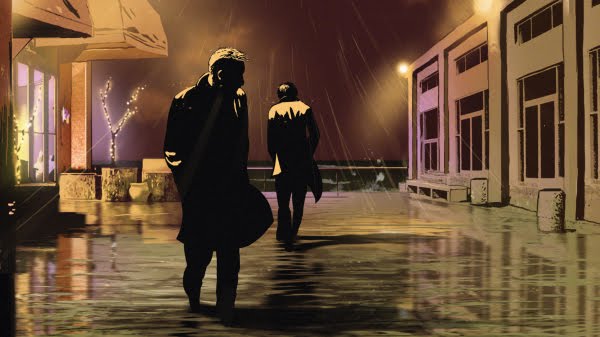
Written and directed by Ari Folman, Waltz with Bashir (2008) is an animated documentary based on Folman attempting to recall traumatic events that occurred one night in September 1982 when he was just 19. During that night, over 3000 Palestinian refugees were massacred by Christian Militia. The area was surrounded by soldiers from the Israeli army, who let the Militia into the refugee camps. Folman was one of those Israeli soldiers and witnessed the Sabra and Shatila massacre. Twenty years on, Folmans memory of the events of that night are blank and he implies, through the film, that the Israelis have also intentionally blanked these events from their minds.

“Over the past quarter-century, the massacre's horror has been absorbed and repressed within the Israeli mind, Folman suggests, but only partly. The very concept of Israel's partial or indirect guilt, established by the government's own Kahan commission, and therefore a guilt which Israel can concede without admitting to direct culpability, makes it a uniquely painful and potent subject. It's a reproach drifting just beneath the surface of memory and liable to break cover at any time.” 
- (Bradshaw 2008)

Folman embarks on a process of tracing and talking to old friends and contacts, including an expert in post-traumatic stress, to try to piece together the truth about himself and the role he played in those events, which proves to be shocking and ugly. Folman was well placed to understand the horror of the massacre as both his parents had survived the Holocaust.

Fig 2. Waltz with Bashir (2008) [Film Still]

The film took around 4 years to complete and is animated apart from one section of archive news footage. The animation style is unusual, using standard animation combined with Adobe Flash. Each drawing was dissected into many hundreds of parts which were then moved around in relation to the other cut parts of the image, which gave the impression of movement. This technique was developed in Israel by Yoni Goodman at the Bridgit Folman Film Gang Studio.


Fig 3. Waltz with Bashir (2008) [Film Still]

The film had a mixed reaction – some audiences found the subject matter contentious and uncomfortable. However, the film attracted many awards including a Golden Globe in 2009 for Best Foreign Film, a British Independent Film Award (BIFA) in 2008 for Best Foreign Independent Film, and in 2009 the Directors Guild of America for outstanding directing.


Bibliography
Bradshaw, P. (2008) Waltz with Bashir [Online] At: https://www.theguardian.com/film/2008/nov/21/waltz-with-bashir-folman (Accessed 08.05.18)

Illustration List
Fig 1. Waltz with Bashir (2008) [Poster] At: https://www.imdb.com/title/tt1185616/?ref_=nv_sr_1 (Accessed 08.05.18)
Fig 2. Waltz with Bashir (2008) [Film Still] At: https://www.imdb.com/title/tt1185616/mediaviewer/rm498439168 (Accessed 08.05.18)
Fig 3. Waltz with Bashir (2008) [Film Still] At: https://www.curzonartificialeye.com/waltz-with-bashir/ (Accessed 08.05.18)

Paprika: A Review

Fig 1. Paprika (2006) [Poster]
Paprika (2006) is a 2D animated film directed by Satoshi Kon. It is fundamentally a surrealist film focusing on reality and dreams merging, being based on the 1993 novel Paprika written by Yasukata Tsutui.

A machine has been developed that allows therapists to enter the dreams of a patient, enabling the mind of the patient to be probed to reveal their inner most thoughts, desires and repressed memories. Using the machine, called the DC mini, the therapists aim to cure various psychological problems.


Fig 2. Paprika (2006) [Still]

As the plot unfolds, the technology is stolen and the characters involved in developing the machine, Dr Atsuko Chiba (who’s dream persona is Paprika) and Kosaku Tokita realise that the machine has been used on others around them as they become aware of behavioral changes completely out of character. The machine, in the wrong hands, could be used to influence behaviour and events in specific individuals in a type of mental/physiological terrorism. Assisted by a patient who has been receiving treatment for a recurring dream, Officer Konakawa, they team up to explore the real world, and the depths of the dream world in order to identify the culprit and restore order.


In the world of Japanese animation, which generally welcomes experimental weirdness, Kon is renowned for being particularly weird and experimental. Like David Lynch - a film-maker Kon is frequently compared to - he is obsessed with the dreaming mind.
- Naylor, 2008

The film Inception (2010) written and directed by Christopher Nolan, has clearly been influenced by Paprika – both films use a piece of electronic equipment to get into the dreams of the subject with the aim of influencing change. Some scenes are almost identical in Inception, presumably as a homage to Paprika. For example, in Paprika, Konakawa dreams of a man who is suspended above the floor during a fall in a hotel hallway and in Inception, characters fight midair in the same hotel hallway setting.


Fig 3. Paprika (2006) [Gif of Transition]

Satoshi Kon was a master at editing, and it shows in this film. His quick cuts and seamless transitions add to the dream-like quality of the film, immersing the audience in the reality he chose to present at that moment. Kon's work was about the interaction between dreams, memories, nightmares, movies, and life. The opening four minutes of Paprika (2006) has five dream sequences, and every single one is connected by a match cut. For comparison, the opening fifteen minutes of Inception (2010) has only four interconnected dreams, with just one match cut. Over the course of ten years, he pushed animation in ways that aren't really possible in live action. Not just elastic images, but elastic editing - a unique way of moving from image to image, scene to scene.


Bibliography:
Naylor, A. (2008) Paprika: the stuff of dreams for filmgoers [Online] At: https://www.theguardian.com/film/filmblog/2008/jun/17/paprikathestuffofdreamsfo (Accessed 08.05.18)

Illustration List:
Fig 1. Paprika (2006) [Poster] At: https://www.imdb.com/title/tt0851578/?ref_=nv_sr_1 (Accessed 08.05.18)
Fig 2. Paprika (2006) [Still] At: https://images.justwatch.com/backdrop/8545857/s1440/paprika (Accessed 08.05.18)
Fig 3. Paprika (2006) [Gif] At https://youtu.be/oz49vQwSoTE?t=2m15s (Accessed 08.05.18)